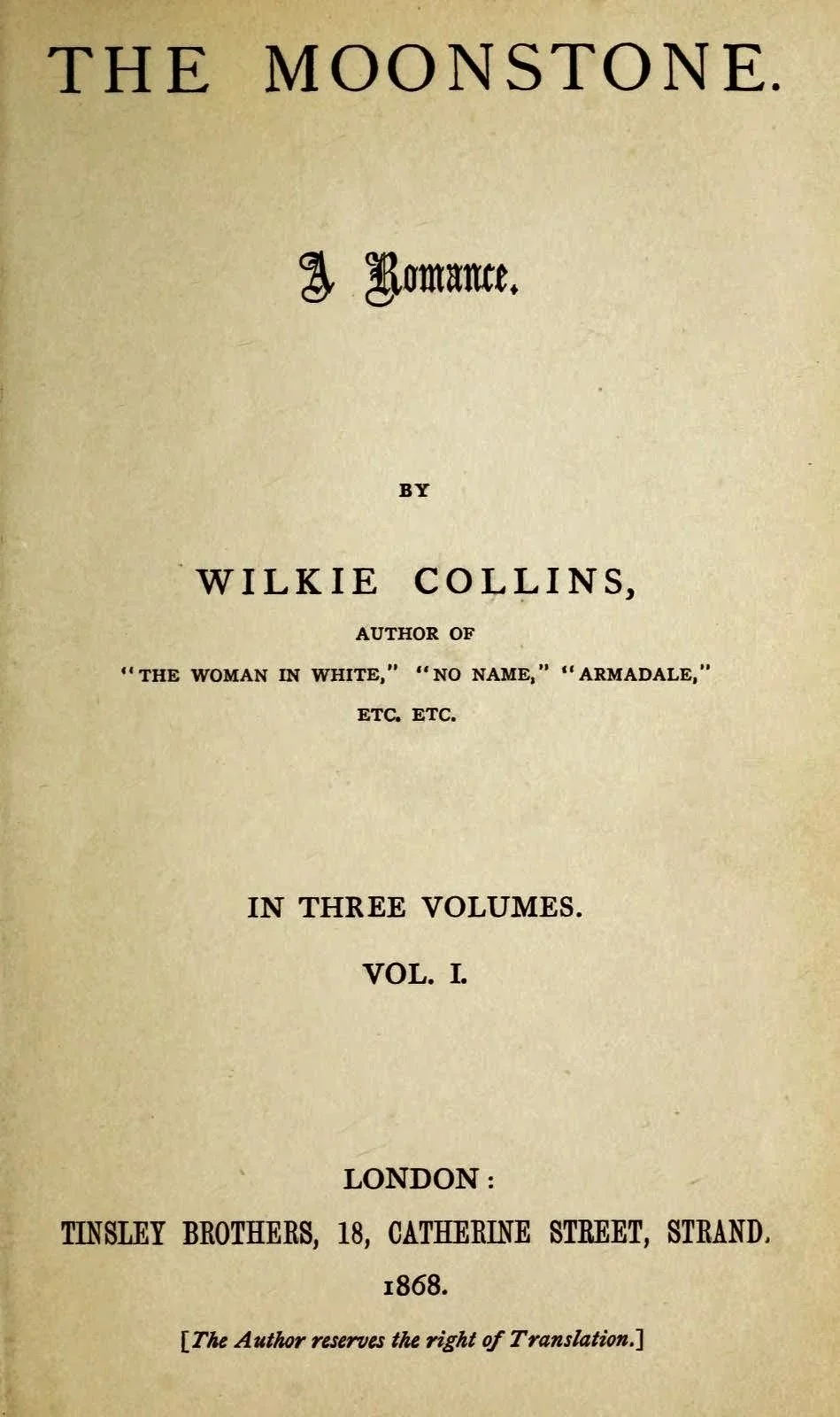
The Moonstone is widely considered the first, and one of the best, modern English detective novels. It established foundational genre conventions; structure, a skilled detective, and a complex, suspenseful mystery, while offering a critical look at Victorian-era themes of colonialism, class, and social hypocrisy.
Academic Articles
-
Christiane Gannon argues The Moonstone’s disjointed composition critiques Victorian Christianity and the Western concept of individualism. She discusses the portrayal of Hinduism and Eastern religions as exemplifying communal spirituality opposing the individualistic Western Christian ideology. The novel's fragmentation illustrates England’s spiritual rift, a result of imperialism and Christian moral authority. The novel critiques imperialism’s social conceit, and by suppressing other cultures, England loses its spiritual unity. The Moonstone imagines intercultural cooperation and the unconscious consideration, emphasizing the constraints of English practices and prejudice.
Gannon, Christiane. “Hinduism, Spiritual Community, and Narrative Form in ‘The Moonstone.’” Dickens Studies Annual, vol. 46, 2015, pp. 297–320. JSTOR, http://www.jstor.org.ezproxy.waterfield.murraystate.edu/stable/44372257. Accessed 23 Mar. 2026.
-
This article explores Wilkie Collins's The Moonstone (1868) in relation to Victorian ideals of masculinity, particularly contrasting the masculine Christian ideal with the novel’s portrayal of masculinity embodied by its detective characters. The author argues that Collins intentionally crafts a novel that physically and emotionally engages its readers, promoting a form of masculinity defined by nervousness and intellectual detection rather than athleticism and stoicism. By investigating the novel’s narrative, characterization, and especially its typographical presentation, the paper sheds light on The Moonstone as a physiological and embodied reading experience that challenges dominant mid-Victorian masculine paradigms.
KARPENKO, LARA. “‘A Nasty Thumping at the Top of Your Head’: Muscularity, Masculinity, and Physical Reading in ‘The Moonstone.’” Victorian Review, vol. 38, no. 1, 2012, pp. 132–54. JSTOR, http://www.jstor.org.ezproxy.waterfield.murraystate.edu/stable/23646858. Accessed 23 Mar. 2026.
-
Hosanna Krienke examines the correlation between gender, health, and rehabilitative reading in The Moonstone. She investigates how Victorian literary reviewers and convalescent autobiographers insisted male reading was necessary, healthful reprieve from industrial overwork, divergent from the pathologized concept of feminine sensation reading. Krienke draws attention to The Moonstone’s distinct incorporation of masculine recreation and sensational mystery, demonstrating the novel obscures gendered reading characteristics by interlacing rehabilitative reading habits with a sensationalist plot. Krienke argues that the novel reveals varied and conflicting social and gendered roles.
Krienke, Hosanna. “‘The Wholesome Application’ of Novels: Gender and Rehabilitative Reading in The Moonstone.” Victorian Review, vol. 46, no. 1, Mar. 2020, p. N.PAG. EBSCOhost, https://doi-org.ezproxy.waterfield.murraystate.edu/10.1353/vcr.2020.0016.
-
Clarke argues that Collins used his narratives to critique racism and religious intolerance, aligning his views with emerging secularism. Clarke defines secularism as a worldview that embraces diverse belief systems and recognizes the multiplicity of spiritual experiences. Clarke highlights Collins's narrative techniques in 'The Moonstone', showing how multiple perspectives reveal the subjectivity of moral and political judgments. He also examines the novel's critique of imperialism and its complex portrayal of religious and cultural conflicts.
Clarke, Micael M. “‘INVADED BY A DEVILISH INDIAN DIAMOND’: WILKIE COLLINS’S ‘SERMON FOR SEPOYS,’ THE MOONSTONE, AND THE EMERGENCE OF A SECULAR MODERNITY.” Religion & Literature, vol. 49, no. 2, 2017, pp. 1–22. JSTOR, https://www-jstor-org.ezproxy.waterfield.murraystate.edu/stable/26773745. Accessed 13 Apr. 2026.
-
Glendening explores hybridity through its references to roses, symbolizing cultural and racial mixing. The novel's central characters embody hybridity, suggesting that mixing might benefit Britain. The controversy between Inspector Cuff and the head gardener about growing moss roses highlights the novel's themes of hybridity and imperialism. Cuff's love for roses and his conservative views contrast with the novel's progressive implications about hybridity. The historical context, including the Irish Potato Famine and the Indian Mutiny, underscores the novel's concerns about the effects of imperialism and social upheaval on British society. The characters Rosanna and Lucy challenge class and gender norms, further illustrating the novel's themes of hybridity and social justice.
Glendening, John. “War of the Roses: Hybridity in ‘The Moonstone.’” Dickens Studies Annual, vol. 39, 2008, pp. 281–304. JSTOR, http://www.jstor.org.ezproxy.waterfield.murraystate.edu/stable/44372199. Accessed 13 Apr. 2026.
Alternative Text
-
After attending a seance, the doubtful narrator tells his friend that he thinks Clairvoyance is mimicking a clairvoyant. His friend asserts that clairvoyants are real and details a story that occurred thirteen years earlier in Paris. In a mesmeric coma a clairvoyant accurately describes Eugene; she recounts the events leading to his supposed suicide. The narrator concludes by stating that he remains skeptical of the supernatural. The writer creates an absorbing mystery that observes the tension between skepticism and mysticism.
-
As a short story that centers on an unusual criminal act, “Guile Up To Date” “Guile Up To Date” examines class distinctions, gender roles, and women’s education.
-
This tale recounts how a wealthy Victorian household is upset by a questionable death. A doctor witnesses the dubious and irregular behavior of those around him, and his encounters steer him to the vital information that is more ominous than he expected. This short story explores theme of mental instability and rationality.
-
This story features a haunting by a ghost whose manifestation is related to a sinful truth. While the characters endeavor to comprehend the haunting, the revelation of the ghost’s previous evildoing serves as a resolution. The author concentrates on the then-inescapable tension between science and religion.
-
“The Necromancer” is a frame narrative that revolves around two wealthy, high-class families who plan to join their houses and fortunes through an arranged marriage. It features Gothic and sensational aspects, and focuses on gender roles, romantic love, and the idea of “gramarye,” or occult magic.