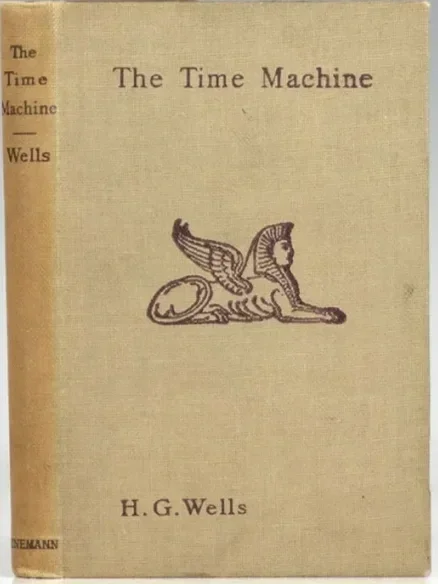
The Time Machine is a warning about social disparity reflecting class imbalance between the wealthy and working class of the nineteenth century, ramification of unrestricted scientific development on humanity, and questions the notion that technological advancement is equivalent to human improvement.
Scholarly Articles
-
Simon J. James explores the correlation between H.G. Wells' anti-religious view and his utilization of Judaeo-Christian symbolism. Wells overtly criticized organized religion; but his works utilize biblical tropes to amplify apocalyptic outcomes. James asserts Wells used apocalypse plots to shock readers into accepting his utopian concept, based on comprehensive education and a World State. He asserts the apocalyptic narratives have two functions: to present the downfall of society and to reveal a promising, educational resurgence of humanity. Wells' apocalypses require societal rejuvenation through scientific advancement and rational law, opposing the influences of the Church and societal constructs.
James, Simon J. “Witnessing the End of the World: H.G. WELLS’ Educational Apocalypses.” Literature and Theology, vol. 26, no. 4, 2012, pp. 459–73. JSTOR, http://www.jstor.org.ezproxy.waterfield.murraystate.edu/stable/23927497. Accessed 23 Mar. 2026.
-
Abitz analyzes The Time Machine in relation to Lee Edelman’s concept of “sinthomosexuality,” a psychoanalytic theory merging Lacanian and queer theory. He explores how Wells’s novel criticizes Victorian principles of advancement, human supremacy, and the future and depicts time travel as an encounter with merciless and despairing futures. The Time Traveler personifies the sinthomosexual, he contests prevailing reproductive futurism and denotes an impasse to established standards about meaning, evolution, and chronology. Abitz asserts the novel disrupts accepted temporal and social conventions, using powerful, often disruptive indulgence for unconventional queer temporalities and futures outside heteronormative structure.
ABITZ, DAN. “SinthomOsexuality and the Fantasy of Travel in The Time Machine.” The Comparatist, vol. 45, 2021, pp. 135–57. JSTOR, https://www-jstor-org.ezproxy.waterfield.murraystate.edu/stable/27085519. Accessed 23 Mar. 2026.
-
Paula Cantor and Peter Hufnagel contend Well’s depiction of the future and technology is influenced by British imperialist principles and concerns and his connection with imperialist narratives. The authors assert British imperialism offered a framework for modernist narratives of isolation, displacement, and cultural exchange. They assert gradual explication in narrative is a conventional modernist practice, and Wells’s narratives established this technique based on imperialist experience. Wells’s works demonstrate the complicated relationship of Victorian imperialism and early modernist views, criticizing empire, the anxiety surrounding modernization, and the foundations of modernist narrative developments.
Cantor, Paul A., and Peter Hufnagel. “The Empire of the Future: Imperialism and Modernism in H. G. Wells.” Studies in the Novel, vol. 38, no. 1, Mar. 2006, pp. 36–56. EBSCOhost, research.ebsco.com/linkprocessor/plink?id=c1d634ee-36bb-34b1-90ff-dfc715032fc4.
-
Yilmez explores Wells’ depiction of the future, addressing Victorian and Edwardian social unease about class, industrialization, and unrestrained scientific advancement. He discusses the characterizations and development of dystopia and apocalypse, their incorporation within Wells' novel, and how the two societies—the Eloi and Morlocks—represent utopia and dystopia. He explains the function of The Time Traveller as a dystopian hero who criticizes his era while surviving in an apocalyptic future. Yilmez contends The Time Machine is a warning exhibiting social, political, and environmental anxieties of Wells' time, cautioning against prospective societal crisis.
Yilmaz, Elif. “Apocalyptic Dystopian Future in the Time Machine by H. G. Wells.” Ankara Hacı Bayram Veli Üniversitesi Edebiyat Fakültesi Dergisi (HEFAD), no. 10, Mar. 2024, pp. 105–14. EBSCOhost, https://doi-org.ezproxy.waterfield.murraystate.edu/10.56387/ahbvedebiyat.1473746.
-
Matthew Beaumont explores how H.G. Wells's novel exemplifies the concept of the uncanny, particularly through its portrayal of class relations and societal transformation. It argues that science fiction, especially in works like The Time Machine, creates a sense of estrangement by revealing how the future is already embedded within the present, suggesting that societal structures are in a constant state of mutation. The article delves into the symbolic significance of the sphinx in the narrative, reflecting Wells's complex views on class dynamics at the end of the 19th century. It also examines the protagonist's encounters with the Morlocks, representing the working class, and how these interactions evoke a sense of foreboding about the future of society. Ultimately, Beaumont presents a political reinterpretation of the novel, linking its uncanny elements to contemporary anxieties about class conflict and the potential for revolutionary change.
Beaumont, Matthew. “Red Sphinx: Mechanics of the Uncanny in ‘The Time Machine.’” Science Fiction Studies, vol. 33, no. 2, 2006, pp. 230–50. JSTOR, http://www.jstor.org.ezproxy.waterfield.murraystate.edu/stable/4241433. Accessed 13 Apr. 2026.
Alternative Text
-
Featured in The Young Emancipator, a magazine intended for the children of Secularists of all classes, this apocalyptic science fiction tale contemplates systematic, scientific causes for the end of the world, which Secularist as a replacement to apocalypse stories their children might encounter from religious doctrines.
-
Set in Manattia, New York city in the future, the story is written as a classical drama. They discuss the former world’s religious restriction, class disparity, uneven division of wealth, and the forced submission of women to men, while they describe the developments made by society. They confess they do not know what to anticipate after death. This story investigates Victorian religious restrictions, class imbalance, and gender roles.
-
The narrator invents a process to convert air into a solid and uses it for construction. After discovering it impacts rainfall, triggering farming disasters, he decides to revert it to a gaseous state to repair the atmosphere. He realizes that the air would have grown so thin that no one would have been able to breathe. This short story comments on the fears of scientific advancement and the role of industrialization.
-
Item description(Later reprinted in The Argosy as "Citizen 504" in December 1896), “The Alien-Thread” is a dystopian story of a regimented future portraying the influence of scientific or perfect societies and predicts the social detachment associated with scientific advancement.
PDF
-
The narrator recounts his experience while escaping a poisonous fog that killed millions of people in London. The “fog” in this fictional warning reflects the fumes caused by soft-coal fires in Victorian London. This short story comments on fears related to scientific advancement, the role of industrialization, and environmental responsibility.
-
“The Purple Death” is about a mad scientist’s desire to help the poor and oppressed by decreasing their numbers. He believes overpopulation is the cause of the planet’s complications. He creates a remedy; a disease that can kill mass populations. This short story comments on anxieties related to scientific advancement and responsibility.
-
As a short story that centers on an unusual criminal act, “Guile Up To Date” examines class distinctions, gender roles, and women’s education.